
Guide to Oklahoma Divorce Records
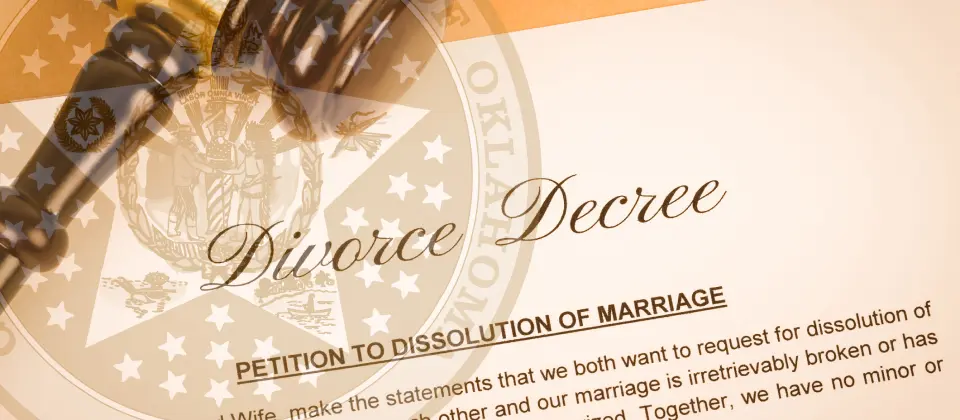
Each state develops and enforces its own set of legal procedures for filing for divorce and accessing divorce information. When couples decide to get divorced in Oklahoma, they file their divorce in the state court system. Once the state court grants the divorce, it issues a formal document that terminates the marriage.
In order to begin the divorce process in Oklahoma, one spouse must file a petition with the district court of the county in which the filing spouse resides. The majority of divorces are handled in District Courts, which have jurisdiction over all family law cases involving divorce, child custody, child support, and spousal support.
Throughout the divorce process, the court creates numerous filings and orders, including the original petition, the other spouse's response, motions, financial disclosure forms, and the final divorce decree. Collectively, these filings and orders form the official divorce record for the case.
A divorce record from Oklahoma can include:
Information about each spouse (including their names)
Where the divorce was filed, the county and court
Grounds on which the divorce was granted
Court orders on children
Spousal support orders
How marital property and debt are divided
There is no statewide database to access official divorce records in Oklahoma. If you need to find a divorce record, you must obtain it from the county court. Newer records may be electronic and available on the county's website, while older records may be paper and located throughout the state's archives and other local locations.
Understanding how divorce records are generated in Oklahoma and the types of information they contain can help individuals better navigate the court system. It also makes it easier to complete the divorce process and locate records, especially when dealing with property division and child custody issues.
Where Are Oklahoma Divorce Records Stored?

Oklahoma does not have a statewide divorce database to search for divorce indexes, nor can you order a certified copy of an Oklahoma divorce record from the state's Vital Records Office like other states. Divorce documents in Oklahoma are strictly a county issue.
All divorce records in the state are kept by the District Court Clerk's Office in the county where the divorce was granted. These include both the complete case file (the actual divorce decree and all filed documents) and the court-issued certificate summarizing and confirming the divorce.
Older divorce papers in Oklahoma are generally kept on file in paper form at the courthouse. These divorce files may be archived either at the courthouse itself or at an off-site location. On the other hand, most recent divorces in Oklahoma have all documentation converted to digital format and entered into an electronic case management system. Many of those electronic systems allow you to view certain information through the court's database.
Is Oklahoma a 50/50 Divorce State
Oklahoma is not a “strict 50/50” divorce state. Instead, Oklahoma is an “equitable distribution” state. In an equitable distribution state, the court decides how to divide marital property based on what it deems fair, not necessarily 50/50 of the total.
According to Oklahoma Statutes Title 43 Section 121, Oklahoma courts divide marital property in a manner deemed by the court to be fair and reasonable. While this may sometimes result in the marital property being divided equally, it does not have to. The judge may exercise discretion in determining an appropriate division of marital property.
The laws in Oklahoma allow judges to consider all aspects of the relationship when deciding how to divide marital assets. Courts will use several factors to determine an equitable distribution in a divorce. A few of these factors are:
Length of Marriage: Generally, longer-term marriages tend to be closer to a “50/50” split of assets than shorter-term marriages.
Contribution of Each Spouse: This can include each spouse's financial contributions and their roles in the home and family.
Each Spouse's Income and Earning Potential: A court may consider each spouse's income and earning capacity to be self-sufficient post-divorce.
Separate vs. Marital Property: In general, courts divide marital property, the property acquired during the marriage, while generally not dividing separate property, any property owned prior to the marriage or gifted to one spouse.
Fault Consideration: Although Oklahoma permits no-fault divorces, courts may consider a party's actions, such as financial misconduct, when they affect equity.
Types of Oklahoma Divorce Records

There are two primary types of divorce records in Oklahoma, both used for legal and administrative purposes. For instance, a person seeking evidence of a divorce for identification, remarriage, or general administrative purposes will typically request an Oklahoma divorce certificate. Conversely, individuals with legal, financial, or custodial issues, such as the parties to the divorce or their attorneys, will most likely require a divorce decree, which provides the specifics of the court's ruling.
Oklahoma Divorce Certificate (Certificate of Divorce)
An Oklahoma divorce certificate summarizes a divorce. The document confirms that a divorce has occurred, but it will not include the specific legal terminology used in the divorce proceedings. Divorce certificates are frequently used for identification, to apply for remarriage, and for general administrative purposes.
In general, a divorce certificate contains the name of each party, the county where the divorce was granted, and the date that the divorce was finalized.
The County Court Clerk's Office in Oklahoma is the only place to request a divorce certificate. To obtain the divorce certificate, the person making the request must provide sufficient information to enable the County Court Clerk to locate the divorce records. This must include the names of both parties to the divorce and the date of the divorce.
Divorce Decree (Final Judgment of Divorce)
A divorce decree is an official document recording the final decision regarding a divorce. The divorce decree is issued by the District Court in the county where the divorce occurred and must be signed by a judge.
A divorce decree is used to enforce all court decisions made during the divorce proceedings and to resolve any disputes between the parties after the proceedings have concluded. Divorce decrees also address any legal or financial matters arising from the divorce.
Unlike the divorce certificate, the divorce decree contains the complete details of the court's final decision, such as:
Division of property and debt
Custody and visitation of children
Child support
Spousal support (alimony), if applicable
Date of final judgment
The differences between these two record types will help ensure that you request the correct type of document, whether it is to prove that a divorce has occurred or to determine the full legal aspects of the divorce.
How to File for Divorce in Oklahoma (Step-by-Step)
It is necessary to meet the residency requirement to file for divorce in Oklahoma per Title 43 of the Oklahoma Statutes, Sections 102 and 103.
According to the law, at least one spouse must have resided in the state for at least 6 months prior to the date the petition is filed. In addition, at least one spouse must have been a resident of the county where the divorce proceeding will be filed for at least 30 days prior to the petition's filing date. The purpose of the residency requirements is to enable the court to establish jurisdiction over the divorce.
To take the final steps toward filing for divorce, it is helpful to determine whether the divorce will be uncontested or contested. An uncontested divorce is generally easier and less expensive than a contested divorce.
An uncontested divorce is one in which both parties have agreed on all major aspects prior to filing for divorce. Examples of typical agreements in an uncontested divorce include property and debt settlement, child custody, visitation schedules for each parent, which party is responsible for child support, and whether either spouse will receive spousal support.
An uncontested divorce typically requires fewer court appearances and less formal procedures. As a result, uncontested divorces are normally quicker and less expensive. When a couple agrees on how to divide their marital assets and share parental responsibilities, they can have much more control over how their divorce ends than when a judge makes those decisions for them.
A divorce is considered contested when spouses cannot agree on one or more key issues, such as custody, support, or the division of property. In these cases, the court becomes actively involved in resolving disputes. The process may include formal discovery, court hearings, possible mediation, and, in some cases, a full trial. Because of these contested divorces are generally more time-consuming and more expensive than uncontested ones.
The outcome of a contested divorce is determined by a judge. Therefore, both parties will have little to no control over the outcome. Once the court has made a decision, it becomes legally binding on both parties, who must follow the court order regardless of whether they agree with the decision.
Step-by-Step Divorce Process
The steps for filing for divorce in Oklahoma may vary slightly from county to county, but generally follow the same process.
Prepare the Filing Packet
The first step for filing for divorce in Oklahoma is to prepare a filing packet.
Identify the Divorce Path (1A vs. 1B): Part of preparing for the filing process involves determining which type of divorce you will pursue: either an uncontested divorce or a contested divorce.
Typical Documents: Gather the following documents.
Petition for Divorce: The first document filed with the court to begin the divorce process. This document outlines the history of the marriage, the reasons you want a divorce, and what you would like the judge to do.
Entry of Appearance and Waiver: This form is used for uncontested divorces in which one party agrees to waive their right to formal service of process and to receive no future hearing notices.
Summons: This form is needed to formally notify your spouse that you have filed a divorce action.
Financial Affidavits: Your financial affidavit is a form detailing your income, assets, debts, and monthly expenses.
Separation Agreement (Uncontested Divorce): This document outlines the terms agreed upon by the spouses in an uncontested divorce.
Supporting Documents: In addition to the divorce petition, other supporting documents are often required in the divorce process, including a marriage certificate, income documentation, tax returns, financial records, information on debts and property, and residency documentation.
Oklahoma is a non-form state. In Oklahoma, the Court Clerk's office does not prepare or provide the above divorce documents. These documents can be purchased from a legal services company or an attorney. Some counties may provide only the waiver and summons forms.
Filing Fees and Fee Waivers (Indigency): The filing fees for divorces in Oklahoma vary by District Court. The filing fees can range anywhere from approximately $150 to $300, depending upon the nature of the case. It is recommended that you call the District Court Clerk's office in your county to find out what the actual filing fee is for your case.
If you cannot afford to pay the filing fee, you may file an application to have it waived, using the Pauper's Affidavit or Affidavit of Indigency form, with the court. If granted, the court will either waive or delay charging you the filing fees so that your case may proceed without having to make an initial payment.
File the Case
After you have obtained all the necessary papers, the next step will be to submit your divorce case to the appropriate court.
Where to File: A divorce case can be submitted to the District Court of the county in which either spouse has met the residency requirements (six months in the state of Oklahoma and thirty days in the county). The District Court is the proper court of jurisdiction for divorce and family law matters.
How to File Your Case: Your divorce case may be filed in one of the following ways:
In Person: You may submit your case documentation directly to the District Court Clerk in the county in which your case is being filed. The clerk may review your case documentation at that time and also answer questions as they arise.
By Mail: Some counties will accept mail-in submissions. All required forms should be included with your submission, along with payment and a self-addressed, stamped envelope so that the clerk may send your returned documents.
eFiling: In many counties in Oklahoma, filing via the Oklahoma eFile system is permitted. Contact your local District Court to see if eFiling is an option in your county.
What You Receive: When you have completed the filing process, the court will send you the following documents.
Case Number: A unique identifier assigned to each case for identification and tracking.
Summons (if Contested Divorce): This is a notice informing the other spouse that a divorce action has been filed.
Initial Notices From the Court: These will tell you which hearings you are expected to attend, how long you have to complete certain tasks, etc.
Service of Process (Primarily for Contested Cases)
Service of process is an official notification to the opposing spouse (respondent) that a divorce proceeding has commenced. By doing this, it provides the respondent with the opportunity to take action through the courts regarding their response.
The respondent can be served by either:
The county sheriff
A professional process server
Certified mail
Once service of process has been accomplished, the party or agency that provided the service must submit a copy of the proof of service to the court. If the respondent cannot be located by the filing spouse after all reasonable attempts have been made, the court may grant permission to use an alternate method of service of process. Some of these include:
Notice is published in a local newspaper in the county where the divorce was filed
Posting at the courthouse
Other approved methods, where the judge may allow for other means of notifying the spouse who cannot be located
If the court approves an alternative method of service of process, the divorce case can proceed regardless of whether the respondent responds. However, the petitioner must prove to the court that they made a good-faith attempt to locate the respondent.
Early Case Phase and Temporary Orders
After a divorce has been filed by one spouse and the other spouse has been served, the divorce proceeding enters its early stage, at which point the Court may enter Temporary Orders. Temporary orders are designed to address any urgent needs that may arise before the divorce is finalized.
It is common for courts to strive to “preserve the status quo,” meaning they attempt to maintain stability as much as possible until the case is completed. This could include maintaining the parties' current living arrangement for their children, maintaining the parties' current financial obligations, or prohibiting either spouse from disposing of or concealing assets.
Temporary orders can be issued on the following:
Temporary Custody and Visitation: The court may establish temporary custodial arrangements, including the minor children's physical residence, a temporary parenting schedule, and the authority to make decisions on behalf of the minor children.
Temporary Child or Spousal Support: A judge may require one spouse to pay temporary child support or temporary spousal support to the other spouse.
Use of the Marital Residence: A judge may also award the exclusive right to use the marital residence to one spouse during the pendency of the divorce proceedings.
Restraining or Protective Orders: If there is an issue of concern regarding safety, harassment, or abuse, a party may request a protective or restraining order to limit contact between spouses.
Financial Disclosures and Discovery
Divorce courts in Oklahoma will usually require both spouses to make full financial disclosures so the court can reach an equitable determination on all matters. Both sides are expected to be truthful and disclose all information in their possession during the discovery phase.
Here are the financial discovery elements in an Oklahoma divorce case:
Mandatory Disclosures: Each spouse must file a financial affidavit listing all income, expenses, assets, and liabilities.
Supporting Documents: Each party must provide documentation, such as pay stubs, tax returns, bank statements, and retirement account information, that supports the information filed. Supporting records serve to maintain transparency and accountability in the case.
Discovery Tools: If the divorce is contested or there is a dispute over financial issues, you can use discovery tools to obtain additional information to help the parties better understand their financial and factual positions in the case.
Requests for Documents: One party may formally request certain records from the opposing side related to the case, such as financial statements, contracts, and account records.
Interrogatories: Written questions asked to elicit answers under oath. May be used to request detailed financial data regarding assets, income, and other pertinent issues.
Subpoena: An order issued to compel a person or organization to produce documents or records that may have been withheld by either party. May be used to obtain records from third-party sources, such as banks, employers, and other financial institutions.
Depositions: Questioning of a party or witness under oath, whose testimony is recorded and may be utilized at trial. Typically used in more complicated or disputed cases.
Case Management and Court Conferences
Early in the case, the judge will review the status of your case at a Case Management Conference. In reviewing the case, the court will determine if you or opposing counsel have submitted all of the mandatory pleadings or other documents. In addition, they verify that you and opposing counsel have complied with mandatory disclosure requirements. At this time, the court may set the timeframes for the next steps in the case.
Later in the process, usually after you and your spouse have exchanged discovery and before a trial date is set, the court holds a Pre-trial Conference. If there is a dispute, the court will assess whether you and your spouse are ready for trial and may encourage you to discuss a settlement. The court may also limit the issues to be tried, address any evidentiary problems, and verify that all other preparations have been completed.
In general, courts expect both parties to be well organized and prepared, and to act in good faith. This includes filing all the required documents as ordered by the court, meeting all court-ordered deadlines, and taking reasonable steps to settle disputes when possible.
Settlement or Trial
Divorce cases filed in Oklahoma can be resolved through settlement or go to trial. Typically, courts encourage parties to settle their differences before going to trial because it gives them greater flexibility to negotiate and resolve issues than enduring the time and cost of litigation.
Once a settlement is agreed on, the parties enter into a written agreement, which the court will then review and approve. There are many ways that parties can settle their differences; however, the most common methods include:
Direct negotiation
Mediation
Attorney-led discussions
If the parties cannot reach an agreement using one of the above methods and they disagree on issues such as property distribution, child custody, or spousal support, the case goes to trial. At trial, the court makes all final decisions regarding the divorce according to Oklahoma law.
At trial, the parties can expect the following:
Evidence and witness testimony
Proposed findings of fact and judgment
The court's decision
Judgment, Waiting Periods, and Finalization
Oklahoma Statute imposes specific waiting times and restrictions on divorced parents who have minor children.
90 Day Waiting Period
Divorce with Minor Children: If you file a divorce with minor children, then you and your spouse must wait ninety (90) days after the divorce filing date. The purpose of the waiting period is to give both spouses sufficient time to consider ending their marriage.
Divorce with No Minor Children: A divorce proceeding without minor children may be concluded within a couple of months. Usually, if both parties agree to the terms of the divorce agreement, the court will conclude the divorce shortly after the divorce papers are filed.
The 6-Month Remarriage Ban: Once the divorce becomes final, Oklahoma Statutes impose additional restrictions on remarriage. Under Section 123, Title 43, of the Oklahoma Statutes, neither parent may remarry until at least 6 months have passed after the entry of the divorce decree.
Child Custody and Child Support in Oklahoma Divorces
In Oklahoma, courts use the “best interest of the child” standard when determining which parent is best suited to have primary custody. Therefore, the court looks beyond each parent's desires and decides which home provides the best opportunity for the child to have the most stable, nurturing, and safest environment possible.
The judge will evaluate various factors such as:
What are the emotional and physical needs of the child?
What type of relationship does the child have with both parents?
Is the child mature enough to express their preference, and if so, what is it?
Has there been past abuse or neglect of the child by either parent?
How willing are each of the parents to work together as co-parents to raise their child
Legal Custody vs. Physical Custody
Legal custody and physical custody are two different things, and understanding how they differ is key to making sense of your divorce proceedings.
Legal custody gives you the authority to make decisions about your child's life, such as medical care, education, and religious training. Parents may share joint legal custody, meaning they both have the right to participate in decision-making, or one parent may have sole legal custody, in which that parent has the final say when a disagreement arises.
Physical custody, on the other hand, establishes where the child resides on a daily basis. There are also two options for physical custody:
Joint Physical Custody, which provides that the child spends an equal amount of time in both household environments, or
Primary Physical Custody, in which one parent has primary physical custody of the child, and the other parent has visitation or parenting time.
Child Support Guidelines and Enforcement
In Oklahoma, child support is determined using the Income Shares model, which accounts for both parents' incomes and the children's needs. This model provides for maintaining the same standard of living for the children as would have been the case if the parents had stayed together. When determining child support in Oklahoma, the court will take into account the following:
The income of both parents
The number of children
Custody arrangement
Premiums for health insurance
Costs of childcare
How many hours do the children spend with each parent
In Oklahoma, child support orders are binding. Once a judge has entered an order requiring one or both parents to make child support payments, the state may use a variety of enforcement techniques to require compliance, including:
Wage garnishment
Intercepting tax refunds
Suspension of a driver's license or professional license
Imposing a fine or jail sentence
Property, Debt, and Alimony in Oklahoma Divorces
When an Oklahoma couple gets divorced, courts have to figure out how to divide up their marital estate and debts. Additionally, courts will determine whether either spouse is entitled to spousal support after the divorce.
Judges in Oklahoma are permitted to distribute only marital property, not individual assets.
Marital property is defined as all property obtained by the couple while married, regardless of who is named on the title of the property. Examples of marital property include income, homes, cars, retirement accounts, and debt.
On the other hand, separate property belongs to one spouse. Separate property usually includes property or assets acquired prior to the marriage or gifts or inheritances received by each spouse during the marriage. However, when separate property is combined with marital property, it becomes marital property.
Debts are also to be divided like all other marital assets. In Oklahoma, debts incurred by either spouse during their marriage are usually considered “marital” debt, regardless of whose name they were taken out in. When determining how to allocate marital debt, a court will take into consideration the following factors
Whether each party has the ability to pay its share of the debt.
The spouse who incurred the debt and the reasons for the debt.
To what extent did the spouse who incurred the debt benefit from the debt incurred?
The total amount of marital property allocated to each of the parties.
Alimony, also known as spousal support, does not automatically follow divorce in Oklahoma. It is considered when a financial disparity between two parties results in one party being unable to provide for their needs after divorce. Oklahoma recognizes three types of alimony. Each type of alimony serves a specific function.
Periodic alimony is the most common type of alimony. The court awards this type of alimony through regular monthly payments over a set period.
Rehabilitative alimony is short-term and is generally used to assist an individual in becoming self-sufficient. This could be through the use of living expenses while the person completes education, job training, or returns to work.
Lump-sum alimony is a single, one-time payment to the spouse who was granted alimony. Lump-sum alimony may be paid all at once or in multiple payments.
Errors, Omissions, and Corrections in Oklahoma Divorce Records
Errors can occur in divorce documents. Most of these errors are simply clerical; however, they can result in serious consequences if left uncorrected. Common errors include incorrect dates, misspellings of names, omitted information, or inconsistencies across different sections of the document.
To correct an error on your divorce certificate in Oklahoma, you will need to send a letter requesting the correction to the District Court Clerk's office of the county where your divorce was finalized. Your letter should clearly state the error and include copies of documentation to support the correct information.
To amend a divorce decree, you will need to file a motion for an amended decree in the same district court that originally finalized your divorce. You will also need to submit all of your evidence and supporting documentation to the court. The courts will then review this information and determine whether an amended decree is warranted based on the facts presented.
After the correction, you may obtain an updated copy of your divorce certificate or an amended copy of your divorce decree from the District Court Clerk's Office where your divorce was finalized.
How to Access Oklahoma Divorce Records

Oklahoma is unique in that it handles all divorce records through the courts, rather than having multiple entities handle different types of divorce records.
Online
Some limited access to divorce cases may be obtained through court public record search services, such as Oklahoma State Courts Network (OSCN) or On Demand Court Records (ODCR). However, neither service will have a full copy of the divorce decree or an official divorce certificate.
In person
You can obtain a certified copy of the divorce decree or divorce certificate from the District Court Clerk's Office in the county in which the divorce was entered. If you visit the office in person, the clerk staff will assist in locating the file and making certified copies of the documents. In most instances, the documents will be ready on the same day you make your request. The clerk will ask for information to locate the document, as well as identification and payment of copying costs.
By Mail
Divorce certificates and divorce decrees can also be requested by mail from the District Court Clerk's Office where the divorce was finalized. To obtain divorce records via mail, you will typically need to submit a written request or a completed request form. Include the applicable fees and a self-addressed stamped envelope for the return of your document.
Oklahoma Courthouses That Handle Divorces
Compared to some other states with several levels of family courts, Oklahoma has a simpler court structure. That makes it somewhat easier to determine which courts are involved in a divorce case once you understand the basic court structure.
Court Authority for Oklahoma Divorce Cases
Divorce cases are heard in the District Courts of Oklahoma. The District Courts are the state's main trial courts and have complete jurisdiction over all family law issues, including divorce, child custody, child support, and the distribution of marital assets. To be recognized in Oklahoma as divorced, a couple must have filed their divorce action, had it adjudicated in the District Court, and received a divorce decree from a District Court judge.
County-Based Filings
Divorces are filed in the District Court of the county in which one of the spouses has established residency. For example, if one spouse lives in Tulsa County, the couple would typically file their divorce action in the District Court of that county, and the divorce records will be available at the county.
Here are the courthouses where you can find divorce decrees and certificates in some Oklahoma counties:
Jurisdiction Basics
Each District Court in Oklahoma has jurisdiction to hear divorce cases. In order to file for divorce in Oklahoma, at least one party must meet the state's residency requirements. Once this requirement is met, the district court of the applicable county obtains jurisdiction over the case. Neither the Court of Criminal Appeals nor the Court of Civil Appeals has the authority to grant divorces or issue divorce decrees in the State of Oklahoma.
Examples of Oklahoma District Courts
There is a District Court in each of Oklahoma's 77 counties. Examples of some county District Courts include:
Rogers County District Court
Tulsa County District Court
Wagoner County District Court
Comanche County District Court
Pottawatomie County District Court
The Role of the District Court Clerk
The District Court Clerk is responsible for the following key aspects of divorces and divorce records in Oklahoma.
Receive and process divorce filings and petitions by assigning a number to each filing.
Deliver court notices and summons to the parties.
Maintain and provide official divorce case files for all divorce cases decided and granted throughout the state.
Provide a copy of the divorce decree and any other applicable court order to the respective party.
FAQ
Are Divorce Records Public in Oklahoma?
Yes. The majority of divorce records are available to the general public per Oklahoma's Open Records Act. However, some of the sensitive information, such as financial data and minor children identity are restricted or redacted.
What Is the Difference Between a Certificate and a Decree?
A divorce decree is the full court order that includes all of the terms of your divorce, including custody, property division, and spousal or child support. A divorce certificate is simply a short document stating that your marriage has been legally terminated.
Do I Need to Know the County?
Yes. In order to find your divorce record, you must know which county your divorce was finalized in.
How Far Back Do Records Go?
Divorce records generally date back many years. Records prior to a certain time may be available only through physical archives located at the courthouse.
How Much Does It Cost?
The cost of obtaining a copy of the divorce record varies. However, in Oklahoma, you can generally expect to pay approximately $1.00 for the first page and $0.50 for each additional page for copies. Certification fees vary widely. They can range anywhere from $0.50 to $10.00 or more per document.
Can I Search Oklahoma Divorce Records for Free?
Not really. Divorce certificates and decrees are rarely available for free online. Third-party vendors that provide copies of divorce records rarely offer free lookups. If you want to access divorce records for free, consider visiting the courthouse where the divorce was finalized.
Table of Contents
- Where Are Oklahoma Divorce Records Stored?
- Is Oklahoma a 50/50 Divorce State
- Types of Oklahoma Divorce Records
- How to File for Divorce in Oklahoma (Step-by-Step)
- Step-by-Step Divorce Process
- Child Custody and Child Support in Oklahoma Divorces
- Property, Debt, and Alimony in Oklahoma Divorces
- Errors, Omissions, and Corrections in Oklahoma Divorce Records
- How to Access Oklahoma Divorce Records
- Oklahoma Courthouses That Handle Divorces
- FAQ